Pairing Cabinets and Countertops: A Suwanee Showroom Guide
Cabinets and countertops are chosen weeks apart from samples the size of a postcard. Here is the process that keeps them from fighting once they are installed.
Our Suwanee showroom exists for one decision: seeing a cabinet door and a countertop slab together before you commit. Homeowners drive in from across Lawrenceville and Gwinnett County to do exactly that, usually in the middle of a kitchen remodel.
Almost every kitchen mistake we get called to fix is a pairing mistake, not a product mistake. The cabinets are good. The stone is good. Together they argue. The reason is structural to how kitchens get bought: you pick a door sample in week two and a slab in week seven, in different lighting, from samples of wildly different sizes.
Here is the process we use in our Lawrenceville showroom to stop that happening.
Step 1: decide which element leads
One material has to be the star and the rest support it. Pick before you shop.
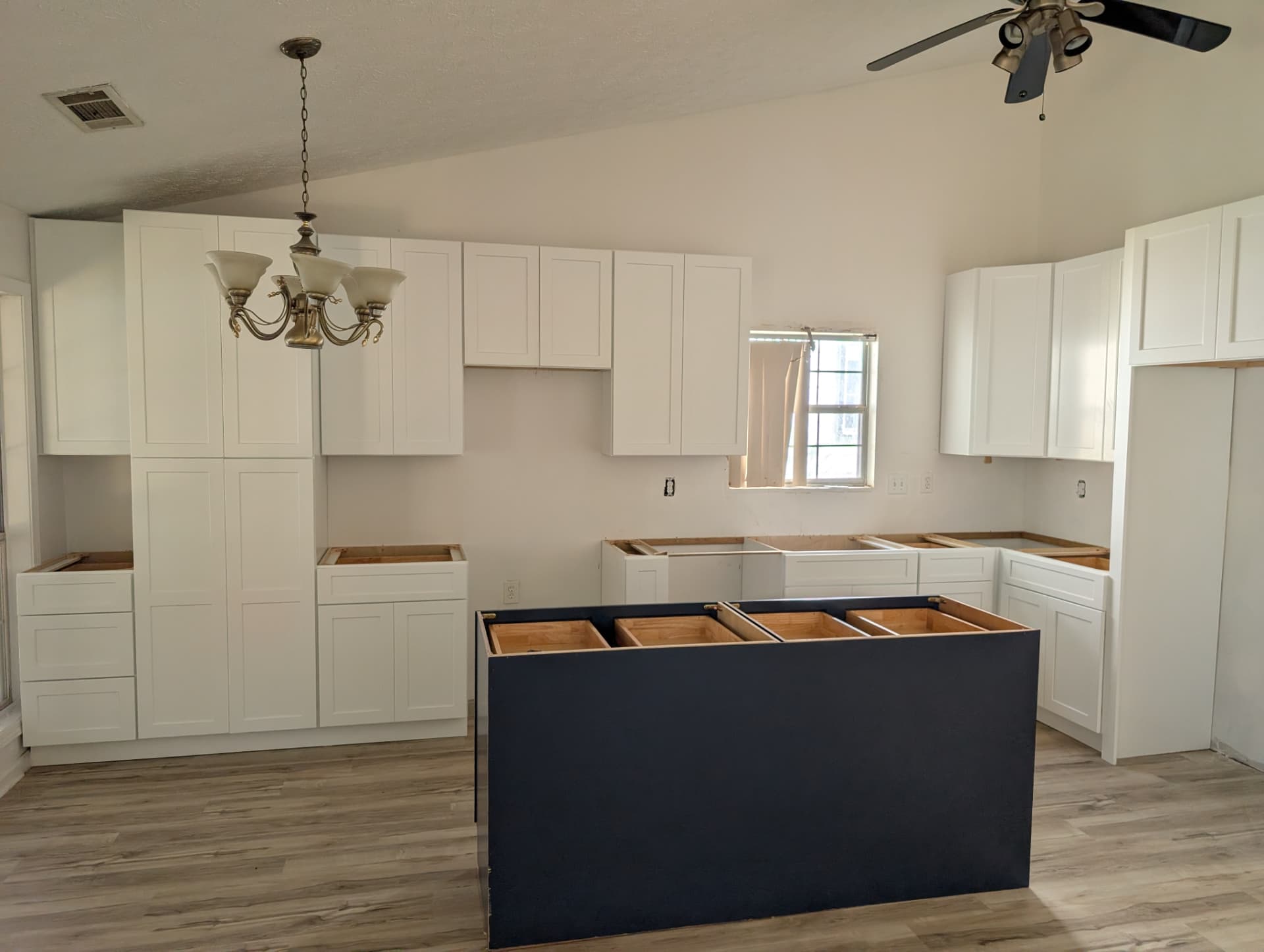
- Stone leads when you have fallen for a dramatic slab — heavy veining, a quartzite with movement, a bold granite. Then cabinets should be quiet: a simple shaker or slab door in a color pulled from the stone's quietest tone.
- Cabinets lead when the cabinetry is the statement — a two-tone kitchen, a stained white oak, a deep green. Then the counter should be subtle: a light quartz with fine veining or a near-solid.
Two statement materials in one room is the most common overreach. A bold slab plus bold cabinets plus a patterned backsplash gives the eye nowhere to rest.
Step 2: match undertone before you match color
Every white has a temperature and so does every stone. A Calacatta-pattern quartz with warm grey-gold veining next to a cool blue-white cabinet will read as dirty, even though both are objectively beautiful. The fix is not a different white — it is the same temperature family.
Practical test: put the door sample flat on the slab in daylight. If either one suddenly looks yellow, pink, or grey next to the other, the undertones are fighting. This takes ten seconds and saves a lot of regret.
Step 3: scale the veining to the room
Slab samples are typically 8 by 12 inches. A kitchen island is 8 feet long. A vein pattern that looks delicate on a sample can look like a road map across a large island, and a large-scale dramatic pattern can be almost invisible on a narrow galley run.
Always ask to see the actual full slab, not just the sample chip. In our showroom you can walk the slab library and see whole pieces. Two things to look at on the full slab:
- Vein direction and density, and whether the fabricator can lay your island out to keep a strong vein running the long way rather than cutting across it.
- Seam planning. Every kitchen over about 10 feet in one run needs a seam. Knowing where it lands before fabrication starts is the difference between an invisible joint and one directly in front of the sink.
Step 4: decide the backsplash strategy early
There are three coherent approaches, and mixing them tends to fail:
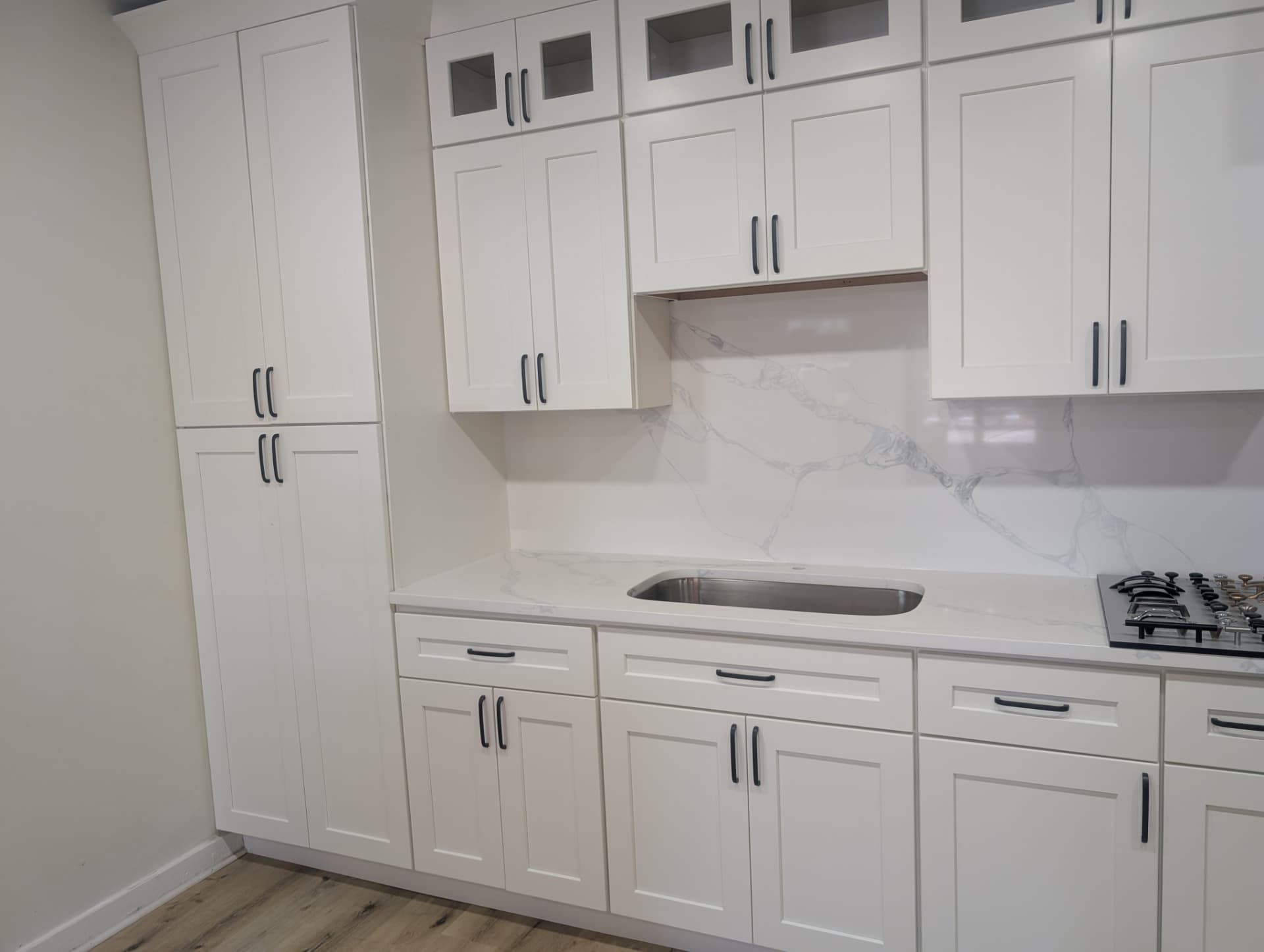
- Continue the stone. Full-height slab backsplash, vein-matched from the same block. Most seamless, most expensive, best behind a range.
- Quiet tile. Subway, zellige, or a simple stacked tile in a shade pulled from the cabinets. Lets the counter be the pattern.
- Feature tile. Only when both cabinets and counter are quiet.
Decide this before you fabricate, because a full-height slab backsplash has to be cut from the same block as the counters and blocks get sold.
Step 5: bring the hardware and the floor into it
Two surfaces homeowners forget until it is too late.
Flooring occupies more square footage than the counters and the cabinets combined, and it sets the room's temperature more than anything else. A warm oak floor pushes everything warm; a cool grey porcelain pulls everything cool. Bring a flooring sample to the showroom.
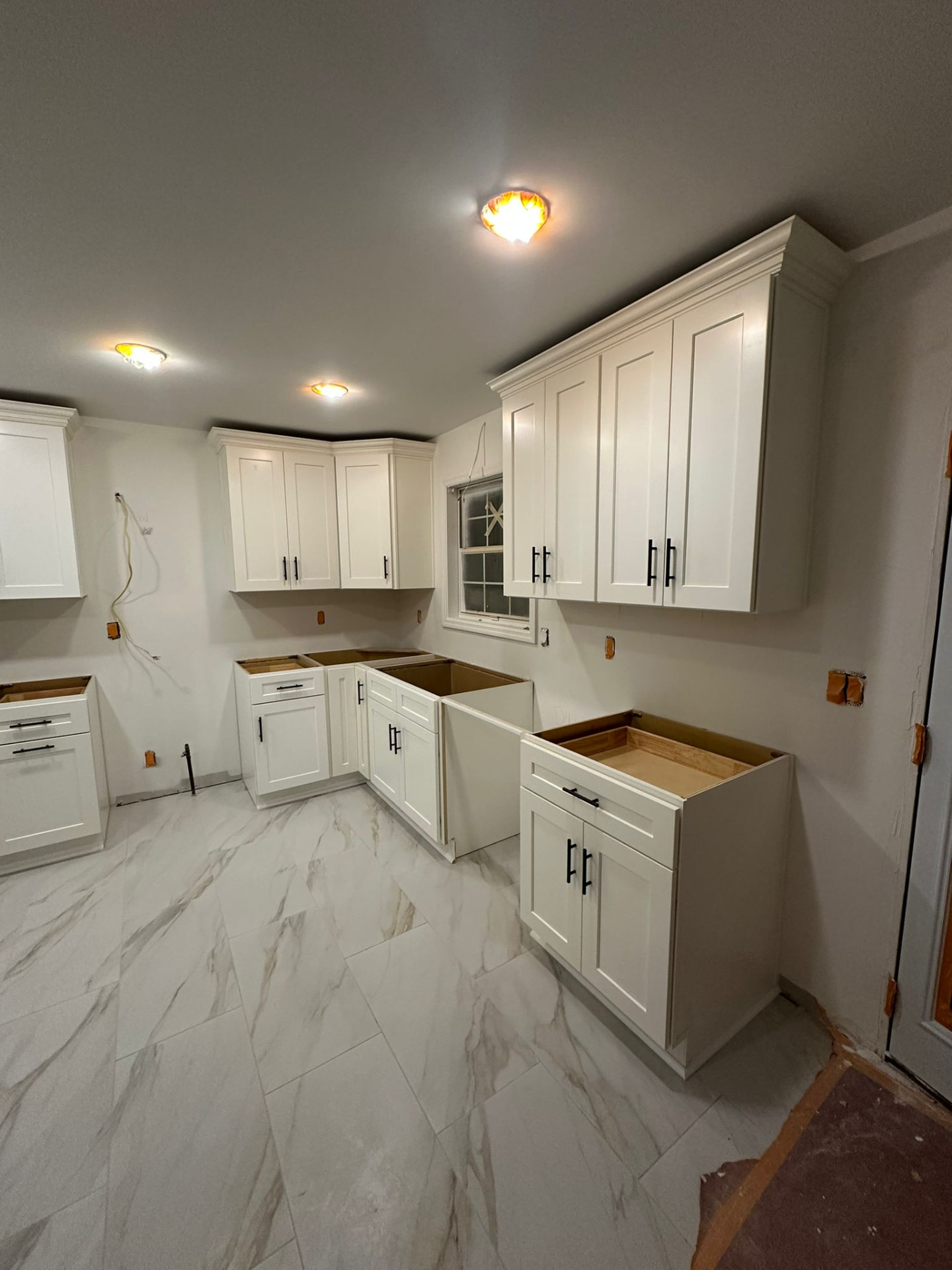
Hardware is the smallest element and the one that ties the scheme together. Matte black with cool whites and grey-veined stone. Unlacquered brass or champagne bronze with warm whites, creams, and stones with gold movement. Polished chrome and nickel are neutral and safe with almost anything.
Step 6: view the samples in your own light
Showroom lighting is not your lighting. Take the door sample and, if we can spare one, a stone sample home. Look at both:
- In morning daylight,
- In late afternoon when Georgia sun comes in low and warm,
- At night under your actual bulbs.
If the pair holds up in all three, it will hold up installed.
Combinations that reliably work
- Warm white shaker + Calacatta-pattern quartz + brass hardware. The most-requested combination in metro Atlanta right now, and it works because both whites sit in the same warm family.
- Two-tone white perimeter and stained white oak island + soft grey quartz. The stone stays quiet so the wood carries the room.
- Deep green or navy cabinets + honed black granite + brass. Traditional, high contrast, very forgiving of daily use.
- Light grey slab doors + near-solid white quartz + brushed nickel. Clean and modern without going stark.
Come see combinations side by side in the showroom rather than assembling them from photographs. Screens lie about undertone, and undertone is the whole game.
Frequently asked questions
Should countertops be lighter or darker than cabinets?
Either works; what matters is that one is quiet. If the countertop has dramatic veining, keep the cabinets simple and low-contrast. If the cabinets are the statement, such as a two-tone or deeply stained kitchen, choose a near-solid or finely veined stone.
How do I match white cabinets to a white quartz countertop?
Match undertone, not shade. Lay the door sample flat on the slab in daylight. If one suddenly looks yellow, pink, or grey next to the other, the temperatures are fighting. Warm whites pair with stones that have gold or beige veining; cool whites pair with grey-veined patterns.
Should I see the full slab before ordering countertops?
Yes, always. Sample chips are about 8 by 12 inches and cannot show vein scale, density, or direction across an 8-foot island. Viewing the full slab also lets you plan seam placement and vein layout before fabrication.
Do I have to choose my backsplash at the same time as the countertop?
If you want a full-height slab backsplash, yes. It must be cut from the same block as the counters to vein-match, and blocks sell out. Tile backsplashes can be chosen later, though it helps to have the tile decided before the countertop template.
Ready to plan your project?
Home Design Cabinetry designs, builds, and installs custom cabinetry and countertops from our Lawrenceville, GA shop, serving Suwanee, Lawrenceville, Suwanee, Lawrenceville, Gwinnett County, and metro Atlanta. Every project starts with a free in-home consultation, a 3D design, and a fixed itemized quote — no pressure and no surprise change orders.
Book a free in-home estimate or browse our project gallery to see recent installs.